Monument Again on Ashland Navy Monument North Chicago 1940
The post-obit are celebrated points of labor history in the land of Illinois:
Downstate labor history sites [edit]
Beckemeyer Coal Miners Monument [edit]
Monument dedicated to Joseph Koch, who along with eight other local miners died in the 1947 Centralia mine disaster. Plaque Reads: Centralia Coal Company Mine No 5 Disaster
On March 25, 1947, a violent explosion struck Centralia coal company mine number five located in Wamac, Illinois. By March 29, it was confirmed that the explosion, combined with the subsequent release of poisonous gas, had taken the lives of 111 of the 142 men working in the mine at the fourth dimension of the accident.
This statue is dedicated to the memory of Joseph Koch Sr. and the other Beckemeyer miners who lost their lives in the explosion. Other victims include: Rodrigo Alvarez, Andrew Farley, Luther Frazier, John Mazeka, Joseph Peiler, John Placek, Anton Skrobul, Alfred Stevens.[ane]
Belleville Labor and Manufacture Museum [edit]
The museum is located in 160-yr-sometime onetime cigar factory at 123 North Church Street in Belleville, Illinois. It contains a collection of photographs, documents and patents relating to labor and industry in the city. The museum is open on Saturdays from x-iv or by appointment.[ii] [3]
George Franklin Bilyeu Monument [edit]
Located in Taylorville, Illinois, and erected in memory of George Franklin Bilyeu (1854–1898) who was killed in Virden, Illinois in 1898 during a United Mine Workers of America confrontation with armed guards who were bringing strike breakers into the Virden mine. The monument is located at the Oak Hill Cemetery, 820 S. Cherokee St., Taylorville, Illinois.
Bloomington Workers' Memorial Monument [edit]
This monument is located in White Oak Park. The park, congenital effectually a quarry, has 100 trees that were donated past labor unions, to honor local asbestos workers and others who died of piece of work-related accidents and disabilities. It also includes a big flag pole, built from steam locomotive bearings, that was moved to the site past local unions in 1996. The flag pole was fabricated in 1942 by Chicago & Alton Railroad Shops employees, as a symbol of war-time patriotism. The Bloomington Normal Trades & Labor Assembly, AFL–CIO, hosts a anniversary each Workers' Memorial Day April 28.
Bloomington labor history mural [edit]
A 12-foot-tall by 18-pes-wide labor history landscape adorns the inside of Laborers Local 362's old hall, 2005 Cabintown Road, Bloomington, Illinois. The mural depicts local labor history, including the Chicago & Alton Railroad shops and the 1922 Shops workers' strike; a 1917 visit by Mary Harris "Mother" Jones in supporting of striking streetcar workers; a 1937 strike at the Beich Candy Company and the 1978 Normal Fire Fighters' strike. The landscape was painted by Kari Sandhaas from 1984 to 1986.
Bloomington & Normal bike trails [edit]
Bloomington and Normal have an extensive wheel trail system, mostly on former railroad correct of style. On these trails are historic markers, some concerning local industries and neighborhoods. On the "Constitution Trail," which runs from Due east Jefferson and Robinson Streets in Bloomington north through Normal, are ten celebrated markers. This trail is on the former 1850s Illinois Central correct-of-way. On this trail are markers detailing the railroad's construction, noting a restored wooden span carrying Virginia Street in Normal over the trail, plus 19th century equus caballus breeding and nursery businesses in Normal. Another east–westward trail in Bloomington, built along the Peoria & Eastern (New York Fundamental system) right of manner, runs from East Lincoln and Due south Clayton Streets in Bloomington north and then westward. It follows the currently operative Norfolk Southern Railway correct of style. This trail has markers noting the local meat packing manufacture (Oakland Avenue), warehouse district (under S Madison Street overpass), the 1917 Streetcar strike [1], which featured Mary Harris "Mother" Jones (South Roosevelt Street), a German immigrant neighborhood (Stonemason Street) and the Marriage Depot (west of Alton Depot Park at South Western and West Forepart Street).
Bloomington Labor leaders [edit]

Patrick H. Morrissey (1862–1916) headed the Alliance of Railroad Trainmen from 1895 to 1909. The son of Chicago & Alton Railroad section foreman John Morrissey and his wife Mary, Morrissey grew upwardly on Bloomington's w side almost the railroad yards. He completed a rare event for a 19th-century working class child – he was one of 27 graduates from Bloomington High School in 1879. Morrissey worked through his schooling every bit a "call boy," summoning railroaders from their homes when it was time for their run. After graduation he followed his dad to the railroad, working as a clerk, brakeman and conductor.
In 1883, trainmen on the Delaware & Hudson Railroad formed the Alliance of Railroad Brakeman, the Brotherhood of Railroad Trainmen after 1890. In 1885 Bloomington workers organized a lodge and Morrissey was a charter member. That year his swain workers elected young Morrissey to represent them at the marriage'southward Burlington, Iowa convention. He defenseless the eye of S.E. Wilkinson, the new system'due south Grand Master, and Morrissey became the BRT'southward clerk, editing the wedlock's "Journal."
In 1889, Morrissey was elected Vice-Grand Master, traveling the country helping establish new lodges. The financial downturn of the 1890s and the Pullman strike defeat left the BRT penniless and dwindling. Wilkinson retired and in 1895 Morrissey was elected BRT Yard Main. The organization had less than 10,000 members and was $105,000 in debt. Morrissey saved the organization, strategically uniting with the Guild of Railway Conductors. Following the Pullman strike all the operating brotherhoods attempted cooperative efforts, but this vicious apart within three years. In 1902 the Conductors and Trainmen confronted the western railroads together, winning a contract which they replicated in other regions. The key strategic move the two organizations made was confronting railroads regionally, rather than individually, thus thwarting the companies' attempts to play workers on one line against another. Although the railway brotherhoods tended to be bourgeois and often aloof from other unions, Samuel Gompers noted Morrissey as one of 20 "outstanding fellows" who answered his pleas for support for West Virginia coal miners in 1902.
When Morrissey left the BRT in 1909, information technology had 120,000 members, held $2 million in insurance funds and had a $1.five million strike fund. The marriage also opened a abode for disabled and anile trainmen in Highland Park, Illinois in 1910. He was noted for his education and equally a public spokesman for the track brotherhoods. With a varied training in railroading, in insurance, and in labor arrangement work, Morrissey was in many ways the antithesis of his predecessors who had, in a powerful and curt way, prepared the way for his analytical and judicious leadership. He was unusually well informed.... This knowledge, together with his forcefulness, tact, parliamentary ability, and rare adept judgment, shortly made him the spokesman of all the railway Brotherhoods in their joint conferences and their leader earlier the public.
For the adjacent 5 years, Morrissey worked in Chicago for the American Association of Railway Employees and Investors, which invested union funds in rail companies. In 1914, he became a special assistant to the president of the Chicago, Burlington and Quincy Railroad. Two years later he was diagnosed with a "nervous breakdown," which was really a brain tumor. He died at age 54 on November 25, 1916 and is cached in Galesburg, Illinois.
Morrissey's brothers all were politically agile in local affairs and moved beyond their working-class background and the railroad. Blood brother Michael was elected Bloomington Police Magistrate, learned constabulary, and served as a successful labor arbitrator and lawyer, becoming Bloomington postmaster during Democratic administrations. James Morrissey joined the Bloomington Burn Department, retiring every bit an assistant chief. John was on the Bloomington Election Committee. The one brother to leave boondocks was William, who went to Denver, was active in the labor movement, wrote for the Denver Postal service and served on the Colorado Boxing Commission.
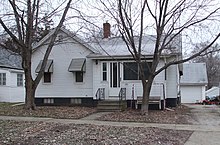
1880s Childhood home of Daniel W. Tracy, IBEW leader, located at 1311 W. Walnut Street, Bloomington, Illinois.
Daniel Westward. Tracy (1886–1954) was some other west-side Bloomington Irish rail worker's son who accomplished national leadership, as president of the International Brotherhood of Electric Workers. New electric engineering science provided Tracy's road to success. Subsequently 1893 his father worked for the local street railway. Tracy completed grade schoolhouse, worked briefly at the C&A shops and and so began working for the street railways, occasionally listed as a laborer and subsequently as an electrician.
Tracy last listed Bloomington as his address in 1913, migrating to the southwest. That year he joined IBEW Local 716 in Houston, working as a lineman in Texas and Oklahoma. Within three years he was business organisation agent for two Houston locals and by 1920 was an International Vice-President for the union, representing the southwest. In 1933, with the union'south membership at a record low because of the Depression, Tracy assumed the national organization's leadership, when there were fifty,000 members.
By 1940, under Tracy's leadership and cheers to new legislation favorable to union organization, the IBEW had 200,000 members. A strong supporter of President Franklin D. Roosevelt, Tracy left the union in 1940 to serve every bit assistant Secretarial assistant of Labor under Frances Perkins. He returned to the union's presidency in 1947, served on the AFL'south executive council, and led the IBEW as it grew to 360,000 members. He helped strengthen the union's apprenticeship programs and established a pension fund in 1946. A fierce anti-communist, Tracy'southward mail service-war reign was marked by tension with unions accused of beingness communist-led. He resigned his union presidency in 1954 and died in 1955. He's buried in Bloomington's St. Mary'due south Cemetery.
John Brown Lennon (1850–1923) is maybe the most fascinating labor leader to impact Bloomington labor. Born in Lafayette County, Wisconsin on October 12, 1850, Lennon'due south family moved to Hannibal, Missouri within two years, where he learned the tailor'due south trade from his father. After some pedagogy, including seven months at Oberlin College in Ohio, Lennon moved to Denver, where he worked farming and mining before returning to the tailor'southward trade. He married June Allen in 1871 and they had one son. Lennon also dates his marriage membership from that year. He apace became active in Colorado activities, helping organize the city's central labor council and running for mayor on a labor-socialist ticket. In August 1884 the Journeyman Tailors Spousal relationship (JTU) reorganized and Lennon represented the Denver tailors. The next year 23 local unions, representing two,481 tailors, met in convention over again. Lennon was elected vice-president.
In 1886, the JTU elected Lennon full general secretary, responsible for the spousal relationship'southward affairs and editor of "The Tailor." He relocated to New York, where one-half the matrimony's membership lived. The spousal relationship's income that commencement year was $300. By 1907, the union had grown to 22,000 members in 400 local unions. Lennon also moved frontwards in the larger labor movement, becoming AFL treasurer in 1890. AFL President Samuel Gompers and Lennon became friends and in 1894 when the AFL president lost his postal service for 1 yr to a socialist opponent, he operated from Lennon's role.
1894 almost destroyed the JTU afterward a disastrous New York strike. With the spousal relationship's membership centered at present in the Midwest, Lennon decided to relocate its national headquarters to Bloomington, setting upwards shop on Jan 1, 1896 in the Boil Building, 427 N. Chief Street. The family residence was at 614 Due east Mulberry Street.
Lennon quickly became agile in local union affairs and helped lead the Trades & Labor Assembly, assisting and promoting local unions. Gompers came to Bloomington on June 23, 1899 to visit Lennon and addressed a labor rally that evening. Lennon took his AFL treasurer position seriously and warned the system against over-expenditure. He too strongly supported Gompers' stances, drawing criticism from Gompers' opponents. In 1909 Lennon was the first president of the AFL's Union Label Department and helped grade a Labor Printing Association.
Lennon lost ability in 1910, when he was defeated as JTU general secretary past Eugene Brais, a Canadian socialist. Brais publicly advocated socialism, but some other pressing event of the early 20th-century might business relationship for Lennon's defeat—booze. Dissimilar many merchandise unionists, who often met and organized in neighborhood taverns, Lennon was a strict prohibitionist and temperance advocate. In a national matrimony movement dominated past Irish Catholic surnames, Lennon was a traditional White Anglo-Saxon Protestant, active in the Masons. He wrote strident manufactures for national Protestant and temperance magazines, condemning strong drink.
Although no longer a national union officer, Gompers insisted on retaining Lennon every bit AFL treasurer, referring to him as "my minister without portfolio." In 1912 Congress established an industrial relations study to hold national hearings. Gompers appointed, to the protest of progressive groups, Lennon as his personal representative.
In 1917, Daniel Tobin of the Teamsters replaced Lennon every bit AFL treasurer. Although he had taken an anti-war stance in 1916, Lennon was appointed by President Woodrow Wilson to the new U.S. Department of Labor's board of mediators, a position he served on through the war years. In 1919, when Lennon was one year short of seventy, his wife died. Lennon quickly remarried Barbara Eggers, a Bloomington school teacher with whom he had developed a friendship later her graduation from Bloomington High School in 1900. Barbara Lennon was an early on abet for teacher unionization in Bloomington schools.
1919 was too a politically auspicious year for Lennon. He took a stance Gompers frowned on, actively participating in forming an Illinois Labor Political party. He ran for Bloomington mayor that year on a Labor Party ticket and narrowly lost election. He died in 1923 and is cached in Bloomington'southward Park View Cemetery, 1001 South Morris Artery, Lot D-41, between his 2 wives.
Centralia Fairview Park [edit]

Illinois Central steam locomotive 2500 salutes the customs'due south railroad heritage at Fairview Park.

This tablet honors rail engineer Robert "Polecat" McMillan in Centralia'due south Fairview Park.
Located in Centralia'due south Fairview Park are two memorials to the area's railroad heritage. Locomotive 2500 is an Illinois Key Railroad iv-8-two "Mountain" locomotive, 1 of 76 built within the railroad'southward Paducah, Kentucky shops between 1937 and 1943. Centralia had large car repair and building shops for the Illinois Central and a big roundhouse. Bordering the locomotive is a tablet honoring railroad engineer Robert I. "Polecat" McMillan. McMillan retired in 1956 after 67 years of railroad service, at age 83. At that time, he was the "oldest locomotive engineer" in the The states. The tablet was erected in 1960.[4]
Chicago & Alton Railroad Shops site [edit]
Now closed and demolished, Bloomington once was a middle for railroad repair and construction past the Chicago and Alton Railroad.[5] Located one-half-way between Chicago and St. Louis, with a secondary line from Bloomington to Kansas City, this central betoken on the railroad is where the railroad located its master shops. Here locomotives, passenger and freight cars were renovated. Once McLean County's largest employer, this railroad reached Bloomington from Springfield in 1853.
It began business organisation in 1847 as the Alton & Sangamon Railroad, starting time construction in 1850 and reaching Springfield in 1853. In 1852 the railroad became the Chicago and Mississippi. In 1855 they located their master repair shops on Bloomington'south due west side, edifice locomotives, freight and rider cars. Local merchants and lawyers donated land to the railroad to induce them to locate their construction and repair facilities here. The Shops eventually extended along the Railroad from Locust Street on the southward to Seminary Street on the north. By 1857 the Shops had 185 employees. George Pullman came here in 1858 to build his first sleeping car. The line from Bloomington to Joliet was completed in 1856 and to Chicago in 1858. In 1861 the line became the Chicago & Alton. On November one, 1867 a fire destroyed the Shops; Bloomington citizens again donated funds to rebuild them. A branch from Bloomington to Kansas City was completed in 1879. Information technology terminated in Bloomington because local citizens over again raised $75,000 to have the line finish in Bloomington, rather than curving n toward Washington to meet up with an existing eastern branch of the company.
These repair shops necessitated skilled arts and crafts workers: boilermakers, machinists, woodworkers, pipefitters, sheet metal workers, blacksmiths and others, employing nearly one,200 at its peak in the early 20th century. The C&A's payroll in 1905 locally was $ane.2 million. In 1882 the Shops burned and the customs raised $55,000 to expand and rebuild them, subsequently the visitor threatened to move them to Springfield. A major burn down once more struck the Shops in 1908. In 1910-12 the customs raised $650,000 to buy land to allow for construction of a new locomotive backshop. On July 1, 1922 the workers, organized in AFL arts and crafts unions, participated in the national rails shop workers strike and the Illinois National Guard was brought in and encamped around the Shops complex. The workers returned to work in October 1922 on visitor terms.
In 1936, the company had i,500 workers in Bloomington, both shop employees and operating crews, who brought in an annual payroll of nigh $ii million. The C&A was absorbed by the Baltimore and Ohio Railroad in 1931, released by that company in 1942, bankrupt in 1946 and then captivated by the Gulf, Mobile & Ohio Railroad, which quickly switched from steam to diesel ability, greatly cut employment at the Bloomington Shops. Today the former C&A line is operated past the Union Pacific Railroad.
What was the Shops complex can exist viewed northward from the West Locust Street span or due south from the W Seminary Street bridge in Bloomington. At i time, 31 buildings were function of this complex, stretching on the west side of the railroad yards between these 2 bridges. Only two buildings remain. On the west side of the former complex, at the east finish of Perry Street, is a brick building from the 1910 era. On the e side of the complex, at West Anecdote and North Allin Street, is the 19th Chicago & Alton freight business firm, built of dolomite rock quarried in the Joliet expanse. This structure is typical of the 19th century buildings which once filled the site. Information technology is now used past a local printing company.
Champaign County Workers' Memorial Monument [edit]

Champaign Canton Workers' Memorial at Dodds Park
Located in Dodds Park, on Parkland Way just due west of Mattis Artery in Champaign, Illinois, near the Olympic tribute. It consists of a circular concrete pad with three big black standing tablets, two engraved with the names of those who take died on the chore in Champaign Canton since 1950. The memorial was dedicated on September 2, 2002.[6]
Decatur Workers' Memorial Monument [edit]
Located at the northwest corner of the Macon Canton Courthouse lawn on the corner of Wood and Water streets in Decatur, Illinois. This monument is defended to workers who have perished due to occupational expiry or affliction on the job. It serves as a reminder for all workers to go on the fight for safe and good for you workplaces. It was erected past Decatur Trades & Labor Assembly, AFL–CIO, and was dedicated in 2000. A ceremony is held each Workers' Memorial Twenty-four hours April 28.
Chatham Railroad Museum [edit]
This museum is located in the old Chicago & Alton Railroad Depot at 100 North. State Street in Chatham, Illinois. The permanent collection includes a library of railroad-related books, photographs, memorabilia, and examples of railroad equipment. The museum is open from 2-4 PM on the second and fourth Sundays of each calendar month. Admission is free.
Blood-red Mine Disaster Site [edit]

Cherry Mine Disaster Centennial observance, November. 2009 Cherry, Illinois
A historical marker is located in the Blood-red Village Park on Illinois Route 89. Just north of Cherry are the remnants of the Cherry Coal Mine where 259 miners lost their lives in the 1909 Ruby Mine disaster, one of the worst mine disasters in The states history. The fire was evidently caused by the ignition of a load of hay intended for mule stables in the mine and it spread rapidly. The disaster led to the passage of stricter mine condom regulations and of the Illinois Workmen'southward Compensation Human action. The cemetery at the southward terminate of Cherry has a memorial erected in 1914 by the United Mine Workers of America; side by side to the Public Library & Town Hall is a new memorial, listing the names of the miners killed, erected to mark the centennial of the disaster in 2009. An showroom of items relating to the disaster is in the Red Public Library.
The Coal Miner [edit]
This statue is located on the northeast grounds of the country capitol in Springfield. Sculpted by John Szaton, this effigy honors miners killed on the job in over a century of mining in Illinois. At the urging of Vachel Davis, a Southern Illinois coal miner, poet and artist, the state Representative Paul Powell introduced a neb to appropriate $15,000 for the creation of a monument honoring the Illinois coal miner. Davis worked with Tinley Park sculptor John Szaton to transform Davis' famous painting into a vii-foot bronze statue. Defended on Oct 16, 1964. The plaque identifying the sculptor and dedication date was added on December 7, 1981.[7]
Coal Miners' Memorial [edit]
The memorial located at 100 E. Chief Street, in West Frankfort, Illinois, adjacent to the Depot Veterans Museum. The granite pyramid is a symbol of Little Arab republic of egypt and honors all coal miners. On December 21, 1951, around 8:30 PM, a methane gas explosion caused a fire in the New Orient Mine No. 2 at West Frankfort, killing 119 miners. The blast was so strong information technology knocked cars weighing several tons off tracks and brought down overhead timbers. The explosion blew out the ventilating equipment in the mine, which had to be repaired before rescue operations could begin.
Coal Miners' Memorial Monument [edit]
This monument is located in Union Cemetery in Panama, Illinois, which is about threescore miles due south of Springfield. The ten-pes tall monument is made of black marble and bears an carving of an early on coalminer and a quotation from John L. Lewis, old president of the United Mine Workers, who lived in Panama and served equally president of the local union in 1910. It is especially dedicated to the vi miners who lost their lives in a 1915 gas explosion in the Panama mine and who are cached in unmarked graves in the cemetery. A total of 144 engraved memorial bricks, which were sold to raise funds for the monument, are laid at the site. This monument was dedicated on May 25, 2003.
Diamond Mine Disaster Site [edit]
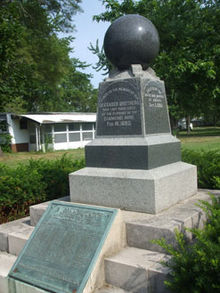
1883 Diamond Mine Disaster marker, Illinois Route 113, Diamond, Illinois
This historical marker is located in Diamond Park in Diamond, Illinois, near Braidwood on the Grundy-Will County line. On Feb 16, 1883, office of the mine collapsed from the weight of melting snow, ice and heavy rains, trapping miners below. Numerous men and boys were killed, some as young as 13 years old. Steam pumps pumped water out of the mine for 38 days and recover efforts did not begin until March 25. Shortly after, the mine was sealed with the remaining 46 miners entombed.
First Coal Mine [edit]
An historical marker (since vanished) located on the north side of Illinois Road 127 at the due east cease of the bridge over the Big Muddy River eastward of Murphysboro, Illinois, commemorates the first commercial coal mining operations in Illinois. These were located in the Big Dingy River bluffs near 100 yards w of the highway bridge. These outcroppings not but supplied local needs, but perhaps as early equally 1810, coal from them was sent by flatboat to market in New Orleans.
Ziegler Coal Miners' Memorial [edit]

Coal Miner Statue, town square, Zieger, Illinois
In the main square in Ziegler, Illinois is the Miners Memorial of Ziegler, with a statue erected in 1974.
Granite City Steel Factory [edit]
This manufacturing plant is probably the longest operating flat roll carbon steel integrated steel mill in the Western Hemisphere. The parent visitor, Granite Fe Rolling Mills started operations in 1878. It may as well be the longest continuously unionized steel factory. When five local unions (United Steelworkers xvi, thirty, 67, 4063 & 9325) merged in 2003, the new became Local 1899. The number was chosen because historical documents verified that a labor agreement between owners and workers existed continuously since 1899.
The United Steelworkers currently represent well-nigh of the 2000+ workforce as Locals 50, 68 and 1899. Other than a brief shutdown from Dec 2008 to June 2009, during the national financial crisis, the institute has operated continuously since 1878.
In the tardily 1960s, financial pressures forced the closely held corporation to exist sold to National Steel Corporation which operated the facility until sold in defalcation to Us Steel. US Steel currently owns and operated the 130+ year old facility which has been modernized and updated many times in the last forty years.
Illinois Department of Corrections Memorial [edit]
A memorial wall at the Pontiac Correctional Center in Pontiac, Illinois, honors the memory of Illinois Section of Corrections workers who died on the job. Dedicated May 9, 2002.
Illinois Firefighters' Memorial [edit]
Located at the lawn of the State Capitol building in Springfield, Illinois, almost Monroe Street, the memorial was defended on May thirteen, 1999, "to the firefighters of Illinois who have given their lives in the line of duty and to those who heroically serve with backbone, pride and honour." The memorial of four life-size, statuary firefighters and a rescued kid on a 14-foot-alpine stone cairn is surrounded by 2,400 ruby-red paver bricks and enclosed by a 2-foot wall. Information technology was built through public contributions and the auction of Firefighter Memorial license plates. A anniversary is held at the memorial each May honoring Illinois' fallen Firefighters.[viii]
Illinois Workers' Memorial [edit]
Located on the lawn of the State Capitol building in Springfield, Illinois near Monroe street. Paid for by donations from union members, this 3,000 pound memorial "is dedicated to the memory of the thousands of Illinois workers killed and injured on the job." The statuary sculpture of three workers on superlative of a polished granite base of operations was dedicated on April 28, 1992, with nearly 800 people in attendance. Illinois AFL–CIO President Richard Walsh and Chicago Federation of Labor President Robert Healey chastened the ceremony, with National AFL–CIO President Lane Kirkland giving the keynote spoken language.[9]
Irish gaelic Railroad Workers' Monument [edit]
The memorial, which consists of a 6-human foot marble Celtic cross with an inscription in English and Gaelic on a bronze plaque, is at the site of a mass grave of 50 Irish immigrant railroad workers anonymously cached in Funk'south Grove cemetery, eight miles s of Bloomington, Illinois. The laborers laid a rail line from Springfield, Illinois to Bloomington in 1852. It is presumed they were the victims of a cholera epidemic. Dedicated on Workers' Memorial Twenty-four hours, April 28, 2000.[10]
Ironworkers' Memorial [edit]
The polished granite memorial is located along Lorentz Avenue, just off of Route 29 in Peoria, Illinois, and honors iii members of Ironworkers Local 112 killed when a portion of the scaffolding they were continuing on while repairing the McClugage Bridge in Peoria gave way, plunging them 60 feet into the Illinois River. The 4 by 5 foot granite slab has a motion picture of the McClugage Bridge and the names of the workers etched in it. It includes a granite bench and landscaping and was dedicated on April 24, 2001.
Jacksonville Labor Temple [edit]
The Labor Temple in Jacksonville, Illinois, is maybe the oldest standing structure associated with organized labor in the United States and is listed on the National Register of Historic Places in Washington, D.C. It was built by pioneering members of the Jacksonville Trades and Labor Assembly in 1904 in downtown Jacksonville and was used for many decades as a headquarters for Labor. In contempo years, the building had fallen into disrepair and was deemed dangerous and was in danger of existence demolished by the City. The Springfield and Central Illinois Central Labor Council, assisted by the Illinois AFL–CIO and concerned matrimony members, formed the Cardinal Illinois Labor Temple Trust committee and established a trust to purchase the building and restore information technology to its original beauty. In June 2004 a bank check for $10,000 was presented to the City of Jacksonville from the state to aid with restoration.
John L. Lewis Grave [edit]
The grave is located in Oak Ridge Cemetery on Monument Avenue in Springfield, Illinois. John Fifty. Lewis (1880–1969), was president of the United Mine Workers of America from 1920 to 1960. He founded the Congress of Industrial Organizations in 1935 and served as its president until 1940. Lewis was built-in in Iowa and worked equally a coal miner in Illinois and Iowa.
Madison County Workers' Memorial [edit]

Located at the archway to Gordon F. Moore Park in Alton, Illinois. This memorial is a life-size sculpture of a worker carrying his hard hat and lunch pail on a red granite base and with winged memorials of granite containing the names of men and women of Madison who died on the job.
John Mitchell Marker [edit]
Historical markers are located in 3 places in Spring Valley, Illinois. These locations include: the intersection of May Street and East Dakota Street (US Road half-dozen), the intersection of Strong Avenue and West Dakota Street, and the intersection of Caroline Street and County Spaulding Street (Illinois Route 89). John Mitchell was born in Braidwood, Illinois, on February 4, 1870 and began work as a breaker boy in the Braidwood coal mines at the age of 12. From 1890 to 1910 he lived at 210 E. Dakota Street in Spring Valley. He joined the United Mine Workers of America in 1890 and its founding, rising through the ranks, and he served as president of the spousal relationship from 1899 to 1908. He achieved national prominence in the settlement of the Pennsylvania anthracite miners strike in 1902. During Globe War I, he served on several city, country and regional agencies, including as chairman of the New York Country Industrial Commission. Mitchell died September 9, 1919, in New York City and was buried at Scranton, Pennsylvania.
Mother Jones Monument [edit]
The monument was erected in 1936 and marks the grave of Mary Harris Jones ("Mother Jones", 1830–1930) in the Union Miners' Cemetery in Mount Olive, Illinois. The monument consists of a granite obelisk with a medallion bearing Female parent Jones' likeness flanked by two bronze statues of coal miners. The monument is listed on the National Register of Historic Places.[eleven]
Moweaqua Coal Mine Museum [edit]
The museum is located on Route 51 in Moweaqua, Illinois. It was opened in 1985 to commemorate the 1932 Moweaqua Coal Mine disaster, in which a gas explosion killed 54 miners. Methane gas escaped into the mine and was ignited by open flame carbide lights. Such lights were subsequently no longer used. Exhibits include coal mining tools and equipment, contemporary accounts of the disaster, and related artifacts. Each Christmas and Memorial Day, a anniversary is held during which 54 flags, each containing an epitome of a coal miner and his lamp, are displayed.
Normal Fire Fighters strike [edit]

This burn station at 604 N. Adelaide Street, Normal, Illinois, was the focal signal for the 1978 burn down fighters strike.
In the jump of 1978, fire fighters in Normal struck for 56 days to win a first contract. Illinois had no public employee collective bargaining law until the 1980s. Seeking spousal relationship recognition, Normal Fire Fighters Local 2442 struck in March 1978. The burn down fighters maintained burn down service from the picket line, refusing to enter the fire station. The Boondocks quickly won a courtroom injunction; the fire fighters were sentenced, en masse, to jail, becoming "Local 24/42"—24 fire fighters who were sentenced to 42 days in jail. They were broken into 2 shifts, one shift in the county jail, the second sentenced to work release at the fire station at 604 N. Adelaide Street in Normal. This brought national attention to the strike and frequent demonstrations were mounted exterior the fire station and at Town council meetings. Subsequently serving their 42 days in jail, negotiations resumed between the Town and Local 2442, resulting in a May 1978 contract between the wedlock and the Town of Normal.[12]
Ottawa Radium Girls Monument [edit]
This 2011 statue at Clinton and Due west Jefferson Streets memorializes the "radium girls," young women who died of radiation poisoning while painting clock dials in the 1920s and 1930s. The resulting publicity over their court case led to stricter industrial exposure laws.
Peoria Workers' Memorial [edit]
The memorial is located in front of the Peoria city hall in Peoria, Illinois, and was erected past the West Central Illinois Labor Quango to honor spousal relationship members who accept died on the job.
Peoria Rocky Glen Park [edit]
In late 2012 the City of Peoria purchased the Rocky Glen surface area, a wooded, rugged area off Farmington Road. On the limestone outcroppings are carvings that betoken to this area every bit a clandestine organizing and meeting point for early mine workers' marriage efforts.
Railroad Workers' Monument [edit]
The monument, dedicated in 1982, is located in Miller Park in Bloomington, Illinois, and commemorates the railroad automobile building and repair shop workers in the former Chicago & Alton Railroad Company shops in the city, which opened in 1854 and ceased operations in the late 1970s. Information technology is composed of a 6-pes tall whistle, which was blown for beginning and ending work and for lunch breaks at the one-time shops, mounted on limestone blocks salvaged from the steel car store walls. A plaque dedicates the monument to the thousands who worked in the shops. The monument was built as a Comprehensive Employment and Grooming Act (CETA) project, giving unemployed youth experience at the structure trades, nether the leadership of retired wedlock structure workers. Adjoining the monument is Nickel Plate Route steam locomotive 639, which was moved to the park in 1959, besides with aid from donated marriage labor. This 1923 production from Lima, Ohio'due south Lima Locomotive Works is a typical 20th century freight steam locomotive, a 2-8-2 wheel arrangement, known as a "Mikado" type. Behind the locomotive is a Southern Pacific Railroad baywindow caboose, which was moved to the park by donated wedlock labor in 1996.
Seneca Shipyard Monument [edit]
Located in Crotty Park in Seneca, Illinois, is a monument to the Landing Transport, Tank (LST), a World War II naval landing vessel. LSTs were built in inland shipyards like Seneca, and so floated downwards the Illinois and Mississippi Rivers to New Orleans, for use throughout the war. Between 1942 and 1945, 157 LSTs were launched from Seneca, Illinois, which had a workforce of eleven,000. The monument includes a reproduction of an LST and panels that reflect the various tasks involved in transport building.
Refinery History Museum [edit]
The museum is located at Illinois Road 111 and Madison Artery in Roxana, Illinois, in a former diagnostic center used for testing cars and engines to produce more efficient fuel. It was founded past retirees from the Trounce Woods River Refining Company in 1993 and contains artifacts and memorabilia from the company. The museum is open from 10 AM to 4 PM on Wednesdays and Thursdays.
Reuben Soderstrom statue [edit]
At the northwest corner of Kent & Park Streets in City Park in downtown Streator, Illinois is a statue to Reuben Soderstrom (1888–1970), erected and dedicated on Labor Day 2012. Soderstrom, born in Minnesota to immigrant Swedish parents, was an Illinois state representative, elected as a Republican, from 1918 to 1936. He became President of the Illinois AFL in 1930 then the combined Illinois AFL–CIO from 1958 until 1970.[13]
Southern Illinois Coal Miners' Memorial [edit]
The monument consists of a stone slab with the figure of a coal miner etched in it. Information technology is located in the metropolis park in Marissa, Illinois, and honors the coal miners of Southern Illinois. It was defended August ane, 1921.
Union Miners' Cemetery [edit]
Located in Mount Olive, Illinois. The cemetery was founded in 1899 originally to business firm the graves of Mt. Olive miners killed in the Battle of Virden, October 12, 1898. Information technology contains the graves of Mary Harris "Mother" Jones and coal miners. The cemetery is on the National Register of Historic Places.
Chicago labor history sites [edit]
Chicago Labor Mural – Teamster Power [edit]
This huge landscape celebrates the 1997 United Packet Service strike victory and includes images of Albert Parsons, Haymarket martyr and his labor activist wife Lucy Parsons. Created in 1998 by Mike Alewitz, located at 300 S. Ashland Teamster City. The edifice has since been replaced and the mural is gone. Few at Teamster City retrieve information technology.
Chicago Labor Mural – The Worker [edit]
Presents the 20th century history of labor-management struggle in the meatpacking manufacture of Chicago. Located at 4859 S. Wabash (south outside), the former headquarters building of District one, United Packinghouse Workers of America, CIO. The edifice is now the Charles Hayes Family unit Investment Heart operated by the Chicago Housing Potency. The landscape was created in 1974 by William Walker,"father of the Chicago landscape movement" and deputed past the Illinois Labor History Social club with funding from the Illinois Arts Quango. The mural was restored in 1998 by Bernard Williams.
Chicago Labor Mural – Fabric of our Lives [edit]
Ceramic and glass tile mosaic, 12 × 14 foot depicting the life, labor and culture of Jewish immigrants in Chicago. Located at 3003 West. Touhy Avenue and created in 1980 by Miriam Socoloff & Cynthia Weiss.
Cigar Makers' Union Monument [edit]
Honors the surrounding graves of Chicago cigar makers. Located in Forest Habitation Cemetery (Waldheim); DesPlaines Avenue in Forest Park, Illinois.
Gompers Park, Chicago [edit]
Located at the corner of Foster and Pulaski Avenues in the Due north Park community, Gompers Park covers nearly 39 acres. The park straddles the Chicago River and features rehabilitated wetlands and a lagoon with pier access that lends itself to many ecology activities. A statuary statue by Susan Clinard memorializes Samuel Gompers (1850–1924), an important figure in the American labor movement. Born in London to a poor family of Jewish immigrants from holland, Gompers began working with his father equally a cigar maker at the historic period of x. He continued this work after he and his family unit settled on New York's Lower East Side in 1863. The following year, Gompers joined the United Cigar Makers and became increasingly concerned virtually conditions for workers and for relations between labor organizations. He was elected equally the president of the Cigar Makers' International Union in 1875 and went on to assistance establish the Federation of Trade and Labor Unions, which was later reorganized as the American Federation of Labor. Gompers served as the organisation'due south starting time and longest–serving president.
Graceland Cemetery [edit]
The cemetery is located at 4001 N. Clark Street in Chicago, with the main entrance nigh Clark Street and Irving Park Route. Amid those buried here are company founders George Pullman, Philip D. Armour, and Cyrus Hall McCormick; Governor John Peter Altgeld, who pardoned the remaining men convicted of the Haymarket bombing; and Allan Pinkerton, founder of the detective agency. The cemetery is open from 8 am to 4:thirty pm.
Margaret A. Haley Plaque [edit]
A plaque honoring Margaret Haley is located in the headquarters of the Chicago Teachers' Union in the Merchandise Mart in Chicago. Margaret Haley was a pioneer of teacher unionism in the metropolis. She was the outset business representative of the Chicago Teachers Federation and a founder of and the first national organizer of the American Federation of Teachers.
Haymarket affair memorials [edit]

Haymarket Martyrs' Monument
On May four, 1886, hundreds of workers gathered at Haymarket Foursquare to demand an eight-hour day and to protest police force action of the previous day against strikers at the McCormick Reaper plant. A bomb was thrown into the crowd by an unknown person, killing one police officer and wounding nearly 100 other people. Police started shooting, killing and injuring other law and workers. Eight agitator leaders who were involved in organizing the meeting were institute guilty of murder, and four were hanged.
Haymarket Martyrs' Monument, by sculptor Albert Weinert, is located in Woods Home (Waldheim) Cemetery, in the 900 block of S. Des Plaines Avenue, just south of the Eisenhower Expressway in Forest Park, Illinois. It marks the graves of seven of the viii Haymarket martyrs and is dedicated to the 4 men hanged for the Haymarket bombing on May 4, 1886. This monument takes its inspiration from "La Marseillaise", the national canticle of France. It depicts a laurel wreath existence placed on the forehead of the fallen hero, every bit the figure of Justice, the Goddess of Liberty represented by Marianne, advances resolutely toward the futurity. The Pioneer Assistance and Support Gild erected the monument and dedicated it on June 25, 1893. It was designated a National Celebrated Landmark in 1997.
Haymarket Foursquare Memorial, defended to the struggles leading to the Haymarket riot, was dedicated on Labor Twenty-four hour period 2004 on the corners of Randolph and Des Plaines streets in Chicago.
Hull Business firm Museum [edit]
Two restored original buildings from Chicago's kickoff settlement house, founded by Jane Addams in 1889, are located at 800 South. Halsted Street in Chicago. Addams devoted her life to social improvement, the abolishment of sweatshops and securing the passage of legislation to amend working atmospheric condition. Hull House is a National Historic Landmark and is operated by the University of Illinois at Chicago. Hours are weekdays 10 am-4 pm, Sun noon-5. Access is free.
Joliet Labor Murals – Preparing the World [edit]
Mural in 1996 by Kathleen Scarboro and Kathleen Farrell is located on the northwest corner of Michigan and Cass Streets in Joliet, Illinois. Features workers on the job in Joliet'southward important wallpaper industry.
Joliet Labor Murals – City of Steel [edit]
Mural in 1997 by Javier Chavira is located on the northeast side of Michigan Street at East Washington Street in Joliet, Illinois. Honors the workers, both women and men, of Joliet's former steel industry.
Memorial Mean solar day Massacre [edit]
A memorial to the persons who died in the Memorial Day massacre of 1937 is located at the union hall of United Steelworkers of America Local 1033 at 11731 Avenue O, Chicago. When Democracy Steel refused to recognize the Steelworkers Organizing Committee, supporters from around Chicago gathered at the matrimony'southward headquarters on Memorial Day 1937 and marched toward the Republic Steel mill. Police tried to stop the march and fired into the oversupply killing 10 people and pursuing fleeing demonstrators.
Lucy Parsons Park [edit]
Located at 4712 Due west. Belmont Avenue in the Portage Park neighborhood of Chicago, the pocket park is named for Lucy Ella Gonzales Parsons (1853–1942), organizer, feminist, and anarchist, the married woman of Albert Parsons, who was hanged in 1887 for participation in the Haymarket Riot. Lucy Parsons was a noted public speaker and author. She attended the founding convention in Chicago of the Industrial Workers of the World in 1905 and led a march of Chicago unemployed in 1915.
Pullman Celebrated District [edit]
centering on 111th Street and Cottage Grove Artery in Chicago, the district extends east to I-94. The kickoff planned industrial town in the nation, Pullman was founded in 1880 by George Pullman, inventor of the railroad sleeping car, for his workers. In 1894 violence connected with a strike over wage cuts caused President Cleveland to send federal troops to restore order. In 1907 the town was annexed to Chicago. A visitor's heart is located at the Florence Hotel, 11111 S. Forrestville.
A. Philip Randolph Pullman Porter Museum [edit]
This privately run museum was founded in 1995 every bit a tribute to Pullman porters, whose union, the Brotherhood of Sleeping Motorcar Porters, was the first black labor union to negotiate a collective bargaining agreement with a major corporation. The museum is located at 10406 S. Maryland Avenue in Chicago.
Workers' Memorial Mural [edit]
A mural dedicated to workers who died on the job is located in the entrance hall of International Brotherhood of Electrical Workers (IBEW) Local 134, 600 W. Washington Blvd. in Chicago. The memorial was dedicated in 1998.
Encounter as well [edit]
- Illinois Labor History Order
References [edit]
- ^ Photos and map on GuidepostUSA 348 [ permanent dead link ]
- ^ Photos and map on GuidepostUSA 47119 [ permanent expressionless link ]
- ^ http://www.laborandindustrymuseum.org/ website
- ^ Photo and map on GuidepostUSA 45669 [ permanent dead link ]
- ^ Koos, Greg and Matejka, Michael Bloomington's C&A Shops: Our Lives Remembered, McLean Canton Historical Lodge, 1988, ISBN 0-943788-04-8
- ^ "Archived re-create". Archived from the original on 2013-06-22. Retrieved 2013-07-24 .
{{cite spider web}}: CS1 maint: archived copy as title (link) - ^ Photo and map on GuidepostUSA 42495 [ permanent dead link ]
- ^ Photo and map on GuidepostUSA 42493 [ permanent dead link ]
- ^ Photo and map on GuidepostUSA 42508 [ permanent dead link ]
- ^ Matejka, Michael, "Under the Celtic Cross: Irish rail workers in cardinal Illinois," Labor'south Heritage, Vol. 11, No. 2, 2001.
- ^ Photos and map on GuidepostUSA 9093 Archived 2007-09-29 at archive.today
- ^ Matejka, Michael, Fiery Struggle: Illinois Fire Fighters Build a Wedlock, 1901-1985, Illinois Labor History Guild, Chicago, 2002.
- ^ http://www.reubengsoderstromfoundation.com/
External links [edit]
- Barbara Egger Lennon Drove, McLean Canton Museum of History
beasleywhissilther1936.blogspot.com
Source: https://en.wikipedia.org/wiki/List_of_historical_sites_related_to_the_Illinois_labor_movement
0 Response to "Monument Again on Ashland Navy Monument North Chicago 1940"
Post a Comment